April 13, 1975 Revisited: Lebanon Between Two Fires—The Hardest Choice Between Civil Peace and Regional Peace Amid Deepening Divisions and a Vanishing Space to Choose
April 13, 1975 Revisited
Fifty years after the events that plunged Lebanon into one of the most devastating civil conflicts in modern Middle Eastern history, the memory of April 13, 1975 is once again casting a long shadow over the country.
The circumstances are different. The actors have changed. The regional environment has evolved. Yet the warning signs feel disturbingly familiar.
Today, Lebanon finds itself trapped between two competing imperatives: preserving civil peace at home and navigating a rapidly changing regional landscape. What once appeared to be a difficult political debate is increasingly becoming a societal fault line.
More worrying still, the debate is no longer confined to political institutions. It is unfolding in homes, universities, workplaces, and across social media platforms. The divisions are no longer theoretical; they are becoming personal.
As an organization working directly with young people from different regions, communities, and political backgrounds, Peace of Art feels compelled to ring the alarm bell.
What we are hearing on the ground should concern every Lebanese citizen.
A Nation Divided by the Idea of Peace
Recent discussions surrounding the possibility of direct negotiations between the Lebanese state and its southern neighbor have triggered strong and emotional reactions across society.
For some, peace represents an opportunity to end decades of instability, prevent future wars, and open a path toward economic recovery.
For others, peace is perceived as surrender, normalization without justice, or abandonment of long-held national principles.
The problem is not that these views exist.
The problem is that fewer and fewer people are willing to coexist with opposing views.
Among the young people we engage with daily, we increasingly hear language that seeks not to debate but to discredit.
Those who advocate exploring peaceful solutions are being accused of betraying their country.
Those who reject negotiations are being accused of serving foreign agendas and external interests.
In both cases, political disagreement is transforming into moral condemnation.
The space between the two positions is shrinking rapidly.
The Return of Dangerous Narratives
Civil wars do not begin when the first shots are fired.
They begin when societies lose the ability to disagree peacefully.
The tragedy of Lebanon’s civil war did not emerge overnight in April 1975. It was preceded by years of polarization, mutual fear, political paralysis, and growing distrust between communities.
Today, some of those same ingredients are reappearing.
Economic hardship has weakened social cohesion.
Political institutions have lost significant public confidence.
Public discourse has become increasingly hostile.
Citizens are retreating into competing narratives rather than engaging in shared national conversations.
Most importantly, people are beginning to view fellow citizens not as political opponents but as threats.
History teaches us that this is a dangerous threshold.
Civil Peace Versus Regional Peace
Lebanon now appears caught in a painful dilemma.
Pursuing a regional peace track may reduce the risk of external conflict but could provoke serious internal tensions.
Rejecting such a path may preserve certain political balances internally while increasing the likelihood of continued regional confrontation.
Both options carry significant risks.
Both have supporters and opponents.
Both have consequences.
The tragedy is that the debate itself is becoming more destabilizing than the options being debated.
What should be a national conversation has become a test of loyalty.
What should be a political discussion has become a source of social fragmentation.
What We See Among Young People
At Peace of Art, our concern comes not from headlines but from direct engagement.
Young people increasingly express frustration, fear, anger, and distrust.
Some believe peace is the only realistic path forward.
Others believe resistance remains essential to national dignity and sovereignty.
Yet increasingly, both sides struggle to accept the legitimacy of the other.
The result is a generation growing up in an atmosphere of suspicion rather than dialogue.
This is particularly alarming because youth often become the first victims of polarization and the last beneficiaries of political settlements.
When divisions deepen, it is young people who inherit the consequences.
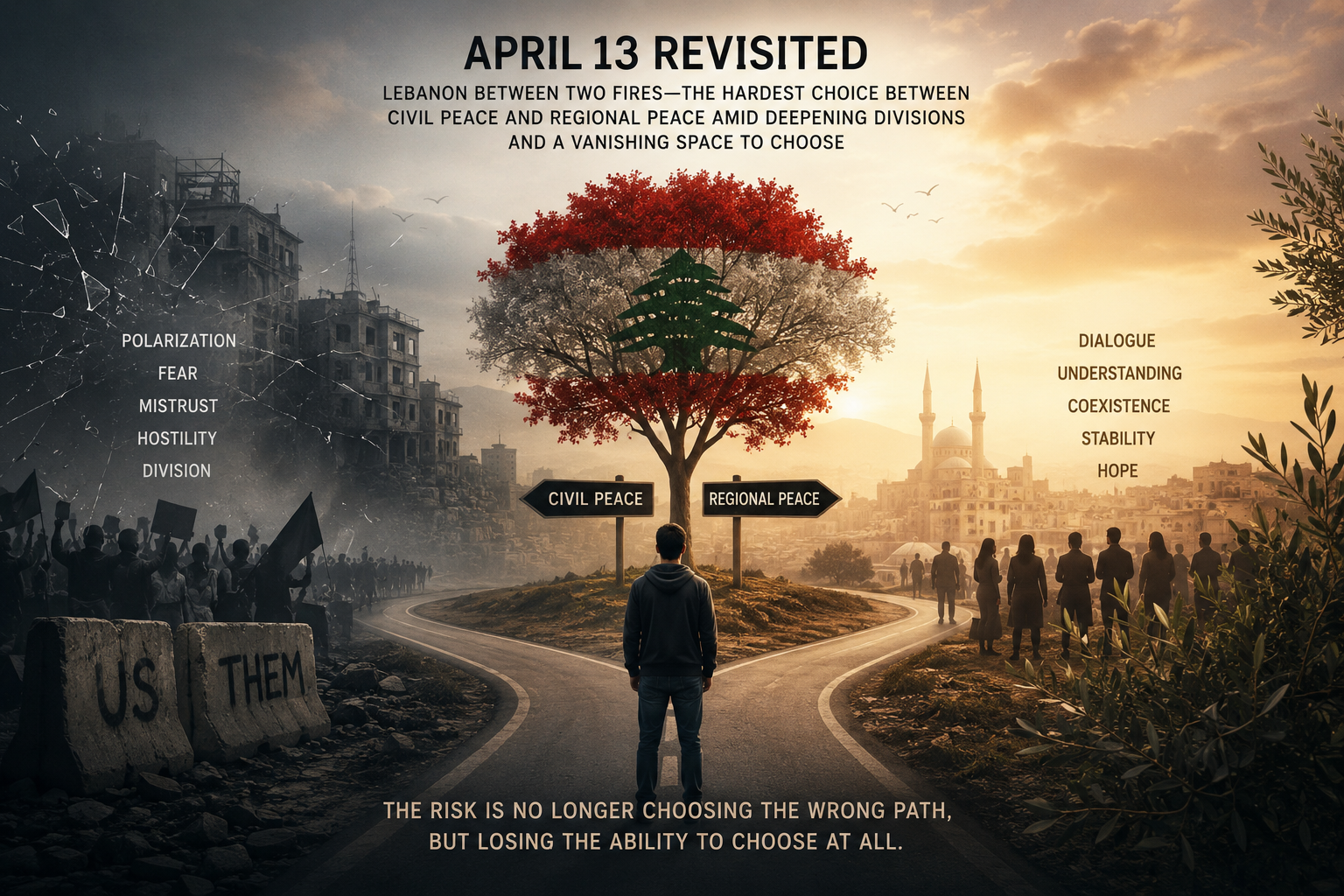
A visual representation of Lebanon’s difficult choice between preserving civil peace and pursuing regional peace amid growing polarization and fading national consensus.
The Most Dangerous Scenario
The greatest risk facing Lebanon today may not be choosing the wrong path.
It may be losing the ability to choose at all.
When institutions become weak, public trust collapses, and social divisions intensify, events can begin to dictate outcomes.
At that point, decisions are no longer made through democratic consensus or national dialogue.
They are imposed by circumstances.
Lebanon has experienced this before.
The memory of April 13, 1975 should remind us that escalation often appears impossible until it suddenly becomes inevitable.
A Warning, Not a Position
This article is not an argument for or against peace negotiations.
Nor is it an endorsement of any political camp.
It is a warning.
As an organization committed to dialogue, youth engagement, and social cohesion, Peace of Art is concerned by what we hear every day across communities.
The language of accusation is replacing the language of conversation.
The willingness to listen is being replaced by the urge to condemn.
The middle ground is disappearing.
History rarely repeats itself in exactly the same way.
But it often begins with familiar warning signs.
Fifty years after April 13, 1975, Lebanon may not be reliving its past.
Yet it would be reckless to ignore the echoes.
The challenge facing the country today is not simply whether it chooses civil peace or regional peace.
The challenge is ensuring that, whatever path is taken, Lebanon does not lose the one thing that makes any future possible:
its ability to remain one society.
By Mahdi Yahya
Founder of Peace of Art
